A
keyboard instrument is a musical instrument which is played using a
musical keyboard. The most common of these is the
piano. Other widely used keyboard instruments include
organs of various types as well as other mechanical, electromechanical and
electronic instruments. In common language, it is mostly used to refer to keyboard-style
synthesizers.Among the very earliest keyboard instruments are the
pipe organ,
hurdy gurdy,
clavichord and
harpsichord. The organ is without doubt the oldest of these, appearing in the 3rd century BC, though this early instrument—called
hydraulis—did not use a keyboard in the modern sense. From its invention until the 14th century, the organ remained the only keyboard instrument. Often, the organ did not feature a keyboard at all, rather buttons or large levers which were operated by a whole hand. Almost every keyboard until the 15th century had naturals to each octave.

The
saxophone (also referred to as the
sax) is a
conical-bore transposing musical instrument that is a member of the
woodwind family. Saxophones are usually made of brass and played with a
single-reed mouthpiece similar to that of the
clarinet. The saxophone was invented by the Belgian instrument maker
Adolphe Sax in 1846. He wanted to create an instrument that would both be the most powerful and vocal of the woodwinds and the most adaptive of the brass, which would fill the vacant middle ground between the two sections. He patented the sax on June 28, 1846 in two groups of seven instruments each. Each series consisted of instruments of various sizes in alternating
transposition. The series pitched in B
♭ and E
♭, designed for
military bands, has proved extremely popular and most saxophones encountered today are from this series. Instruments from the so-called
"orchestral" series pitched in C and F never gained a foothold.

The
tabla (or
tabl, tabla) (
Hindi:
तबला,
Marathi:
तबला,
Kannada:
ತಬಲ,
Telugu:
తబల,
Tamil:
தபேலா,
Malayalam:
തബല,
Bengali:
তবলা,
Punjabi:
ਤਬਲਾ,
Nepali:
तबला,
Urdu:
طبلہ,
Arabic:
طبل، طبلة,
Persian:
طبل) is a popular
Indian percussion instrument (of the
membranophone family), similar to
bongos, used in
Hindustani classical music and in popular and devotional music of the
Indian subcontinent. The instrument consists of a pair of
hand drums of contrasting sizes and
timbres. The term 'tabla is derived from an
Arabic word,
tabl, which simply means "drum."
[1] Playing technique involves extensive use of the fingers and palms in various configurations to create a wide variety of different sounds, reflected in the mnemonic syllables (bol). The heel of the hand is used to apply pressure or in a sliding motion on the larger drum so that the pitch is changed during the sound's decay.

The
tambura,
tanpura,
tamboura or
taanpura is a long-necked plucked
lute (a
stringed instrument found in different forms and in many places). The body shape of the tambura somewhat resembles that of the
sitar, but it has no frets – and the strings are played open. One or more tamburas may accompany other musicians or vocalists. It has four or five (rarely six) wire strings, which are plucked one after another in a regular pattern to create a harmonic resonance on the basic note (
bourdon or
drone function). Tamburas come in different sizes and pitches: larger "males", smaller "females" for vocalists, and a yet smaller version is used for accompanying sitar or sarod, called
tamburi or
tanpuri

The
shehnai,
shahnai,
shenai or
mangal vadya, is an
aerophonic (wind) instrument, a
double reed conical
oboe, common in
North India,
West India and
Pakistan, made out of wood, with a metal flare bell at the end. Its sound is thought to create and maintain a sense of auspiciousness and sanctity and, as a result, is widely used during
marriages,
processions, and in temples of
West India, although it is also played in concerts. The
South Indian equivalent of the shehnai is the
nadaswaram. This tube-like instrument gradually broadens towards the lower end. It usually has between six and nine holes. It employs two sets of
double reeds, making it a
quadruple reed woodwind. By controlling the breath, various tunes can be played on it.
 Cymbals
are a common
percussion instrument. Cymbals consist of thin, normally round plates of various
alloys; see
cymbal making for a discussion of their manufacture. The greater majority of cymbals are of indefinite pitch, although small disc-shaped cymbals based on ancient designs sound a definite note (see:
crotales). Cymbals are used in many ensembles ranging from the orchestra, percussion ensembles, jazz bands, heavy metal bands, and marching groups.
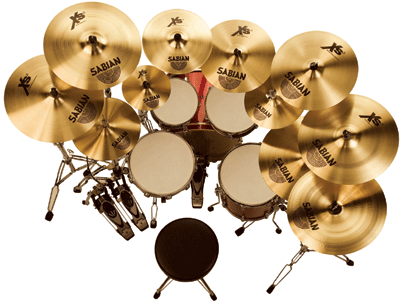
Drum kits usually incorporate at least a
crash,
ride or
crash/ride, and a pair of
hi-hat cymbals

The
trumpet is the
musical instrument with the highest
register in the
brass family. Trumpets are among the oldest musical instruments,dating back to at least 1500 BC. They are played by blowing air through closed lips, producing a "buzzing" sound which starts a
standing wave vibration in the air column inside the instrument. Since the late 15th century they have been constructed of
brass tubing, usually bent twice into a rounded
oblong shape.
There are several types of trumpet; the most common is a transposing instrument pitched in B♭ with a tubing length of about 148 cm. Earlier trumpets did not have valves, but modern instruments generally have either three piston valves or, more rarely, three rotary valves. Each valve increases the length of tubing when engaged, thereby lowering the pitch.

A
gong (
Malay:
gong) is an
East and
South East Asian musical
percussion instrument that takes the form of a flat metal disc which is hit with a mallet.
Gongs are broadly of three types. Suspended gongs are more or less flat, circular discs of metal suspended vertically by means of a cord passed through holes near to the top rim. Bossed or nipple gongs have a raised centre boss and are often suspended and played horizontally. Bowl gongs are bowl-shaped, and rest on cushions and belong more to bells than gongs. Gongs are made mainly from bronze or brass but there are many other alloys in use.
Gongs produce two distinct types of sound. A gong with a substantially flat surface vibrates in multiple modes, giving a "crash" rather than a tuned note. This category of gong is sometimes called a tam-tam to distinguish it from the bossed gongs that give a tuned note. In Indonesian gamelan ensembles, some bossed gongs are deliberately made to generate in addition a beat note in the range from about 1 to 5 Hz. The use of the term "gong" for both these types of instrument is common.

The
Sārangī (
Hindi: सारंगी,
Punjabi: ਸਰੰਗੀ,
sarangī) is a
bowed, short-necked
string instrument of
India which is originated from Rajasthani folk instruments. It plays an important role in India's
Hindustani classical music tradition. Of all Indian instruments, it is said to most resemble the sound of the human voice – able to imitate vocal ornaments such as
gamakas (shakes) and
meend (sliding movements).There are different versions for the meaning and origins of
sarangi but the most logical and widely accepted ones are that the word
sarangi is derived from two
Hindi words:
sau (meaning hundred) and
rang (meaning colour) hence meaning the instrument of 100 colours

A
harmonium is a free-standing
keyboard instrument similar to a
reed organ. Sound is produced by air being blown through sets of
free reeds, resulting in a sound similar to that of an
accordion. The air is usually supplied by
bellows operated by the foot, hand, or knees.In much of Europe, the term
harmonium is used to describe all pedal-pumped keyboard free-reed instruments, making no distinction whether it has a pressure or suction
bellows.

The
piano is a
musical instrument played by means of a
keyboard. It is one of the most popular
instruments in the world. Widely used in
classical and
jazz music for solo
performances, ensemble use,
chamber music and
accompaniment, the piano is also very popular as an aid to
composing and
rehearsal. Although not portable and often expensive, the piano's versatility and ubiquity have made it one of the world's most familiar musical instruments.The piano was founded on earlier technological innovations. The first
string instruments with struck strings were the
hammered dulcimers.
[2] During the
Middle Ages, there were several attempts at creating stringed
keyboard instruments with struck strings.
[3] By the 17th century, the mechanisms of keyboard instruments such as the
clavichord and the
harpsichord were well known. In a clavichord the strings are struck by
tangents, while in a harpsichord they are plucked by quills. Centuries of work on the mechanism of the harpsichord in particular had shown the most effective ways to construct the case, soundboard, bridge, and keyboard.

An
electric guitar is a
guitar that uses the principle of direct
electromagnetic induction or
piezoelectricity to convert vibrations of its metal strings into electric
audio signals. The signal generated by an electric guitar is too weak to drive a
loudspeaker, so it is
amplified before sending it to a loudspeaker. Since the output of an electric guitar is an electric signal, the signal may easily be altered using electronic circuits to add "color" to the sound. Often the signal is modified using
effects such as
reverb and
distortion.
Invented in 1931, the electric guitar became a necessity as jazz musicians sought to amplify their sound. Since then, the electric guitar has become the most important instrument in popular music It has evolved into a stringed musical instrument that is capable of a multitude of sounds and styles. It served as a major component in the development of rock and roll and countless other genres of music.

The
Madal (
Nepali:
मादल), double-headed
drum of Nepalese origin (of the
Membranophone family), used mainly for rhythm-keeping in Nepalese folk music, is the most popular and widely used
hand drum in
Nepal.The Madal consists of a cylindrical body with a slight bulge at its center, closed on both ends (the sides are often referred to as "heads", one head is smaller than the other).
The madal has a strand that goes around the waist of the person playing it to hold it horizontally . Playing technique involves rhythmic struck one either ends(heads) with palm. The heads vibrate to produce sound when struck.
This typical Nepalese percussion instrument is the backbone of most of Nepali folk music. The well-known Nepali musician Ranjit Gazmer introduced this instrument to Bollywood music and has used it in many Bollywood songs such as 'Hum dono do premi duniya chhod chale', 'Kanchha re kanchhi re' and many others. There is also a madal drum from the ancient tribes of India.
The ancient name of Madal was Mardal (मर्दल in Nepali).
Typically, a wooden log is carved so as to form a hollow cavity, called Ghar (घार). The two opposite openings are covered with cow leather. The cow leather on either head also consists of a black inner concentric circle. This layer is made up of a black substance known as Khari (खरी), which is the powdered mixture of Kansh (काँश) and Kit (किट). This black substance give the skin weight and cause the tone to reverberate like a low pitched bell. The heads are not of the same size; the larger and the smaller heads are often refereed to as male and female respectively. The madal's other feature are the strands that overlay the central body. These strands, also made up of cow leather, are used to tune the instrument.

Guitars are traditionally constructed of various woods and strung with animal gut or, more recently, with either nylon or steel strings. Some modern guitars are made of
polycarbonate materials. Guitars are made and repaired by
luthiers. There are two primary families of guitars: acoustic and electric.There are three main types of modern acoustic guitar: the classical guitar (nylon-string guitar), the steel-string acoustic guitar, and the archtop guitar. The tone of an acoustic guitar is produced by the vibration of the strings, which is amplified by the body of the guitar, which acts as a resonating chamber. The classical guitar is often played as a solo instrument using a comprehensive fingerpicking technique.

A drum kit, drum set or (archaic) trap set is a collection of drums and other percussion instruments set up to be played by a single player A drum kit is normally played seated on a drum stool or throne. Most drummers extend their kits from this basic pattern, adding more drums, more cymbals, and many other instruments. In some styles of music particular extensions are normal, for example double bass drums in heavy metal music. On the other extreme but more rarely, some performers omit elements from even the basic setup, again particularly for particular styles of music.


 Most of the Indian musical instruments have evolved over centuries। Each instrument has its own history behind its evolution. Like any other culture's evolution. Bhawani Musical offers Indian instruments in different price categories, from beginner models to professional instruments to special premium instruments which display the craftsmanship of Indian instrument makers.